
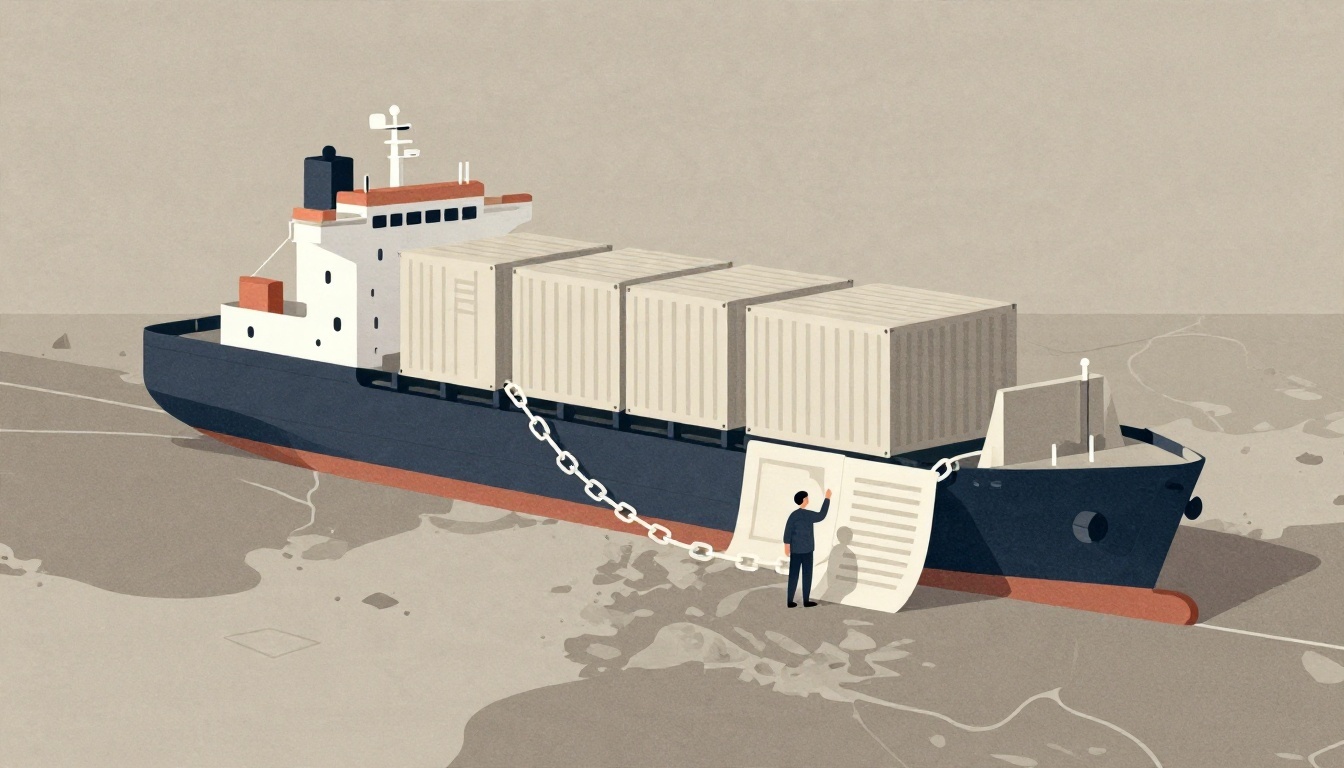
Cross-border commodity supply agreements fail in predictable places: at the point where risk transfers, where payment is released, and where the document chain breaks. If you are structuring a physical commodity deal across jurisdictions, the contract is not a single document but a chain of obligations that must line up. This guide gives you a practical sequence for building that chain so you can ask better questions before signature.
Under Incoterms 2020, what do the C rules and D rules differ on?
Select one answer.
Start with the transaction chain, not the contract template
A commodity-finance transaction is a chain, not a single agreement. Goods, title documents, seller, buyer, lender, warehouse or carrier, payment route, and enforcement jurisdictions must work together. Before drafting, map where control and value move: who owns the goods at each stage, which document releases delivery or payment, and whether receivables are sold, assigned, or pledged. This mapping exercise is practical — a delayed document can block payment, and a mismatch between title and collateral can weaken protection.
Pin down Incoterms and the exact risk-transfer point
Incoterms are internationally recognized terms that clarify the tasks, costs, and risks for buyers and sellers in transactions, as the U.S. Commercial Service explains. They determine the moment at which the risk of loss of or damage to the goods transfers from seller to buyer, and that moment differs by rule. Under C rules, the seller contracts carriage but risk transfers earlier — typically when goods are handed to the carrier — while under D rules the seller transfers risk by placing goods at the buyer's disposal at destination, per the ICC Academy's explanation of C versus D rules.
Two practical warnings follow. First, the party paying freight is not necessarily the party carrying transport risk. Second, Incoterms do not determine ownership transfer or payment terms — those must be expressly addressed and coordinated with the delivery term. Define the delivery point precisely, name the port or place, and align the rule with the transport mode: FOB, CFR, and CIF remain central to bulk seaborne cargoes, while FCA is generally more appropriate for containerized shipments handed to a carrier before loading on board.
Build payment security that matches the commercial timetable
Payment mechanics belong in the contract, not in a side letter. Decide whether you will use letters of credit, wire transfers, or escrow, and address delays, non-payment, and force majeure events explicitly. Currency risk also needs an owner: if prices are denominated in a foreign currency, agree clearly who bears exchange-rate risk, consider currency adjustment clauses, or price in a stable hard currency, as cross-border counsel advise.
Then test the alignment: do guarantees, letters of credit, or export-risk support match the commercial timetable? A payment instrument that matures after the cargo has moved creates exposure the contract may not cure.
Address customs, tax, and transfer pricing early
Customs compliance is jurisdiction-specific: duties, tariffs, classification, valuation, and origin rules vary by country and can reshape landed cost. Where the parties are related, transfer pricing adds another layer. The OECD's BEPS Actions 8-10 guidance recommends that taxpayers document their price-setting policy for commodity transactions and addresses the use of publicly quoted prices under the comparable uncontrolled price method, including a deemed pricing date where the actual pricing date is not evidenced, as EY summarized.
Choose governing law and enforcement forum deliberately
A remedy that works in one jurisdiction may not reach a debtor or asset abroad. Identify which sanctions regimes, governing laws, and enforcement forums matter to the deal, and confirm that the chosen forum can actually enforce against the counterparty's assets. Note also whether the CISG applies: the UK has not ratified it, so it will not apply to sales between UK entities and entities from other contracting states.
A pre-signature checklist
- Map the full chain: goods, title documents, seller, buyer, lender, warehouse or carrier, payment route, enforcement jurisdictions.
- Name the Incoterm, version, port or place, and confirm the risk-transfer point matches your insurance and payment terms.
- Specify who bears currency risk and whether adjustment clauses apply.
- Document the payment instrument and its timing against the cargo movement.
- Confirm customs classification, valuation, and origin treatment in each jurisdiction.
- For related-party deals, document the pricing policy and pricing date.
- Select governing law and forum with enforceability in mind.
- Check that title, collateral, and receivables treatment are consistent across documents.
How the Featured Expert Can Help
VERTEX Strategic Group is a boutique professional services firm that facilitates strategic access and institutional execution across governments, infrastructure, commodities, and cross-border trade. It offers specialized procurement, capital, and commodity pathways for qualified institutional mandates. For mandates that require discreet coordination across jurisdictions, you can learn more at vertex-strategic.com.
Before you sign, test your structure against one question: can you trace where control and value move at every stage? If not, the agreement is not ready.