
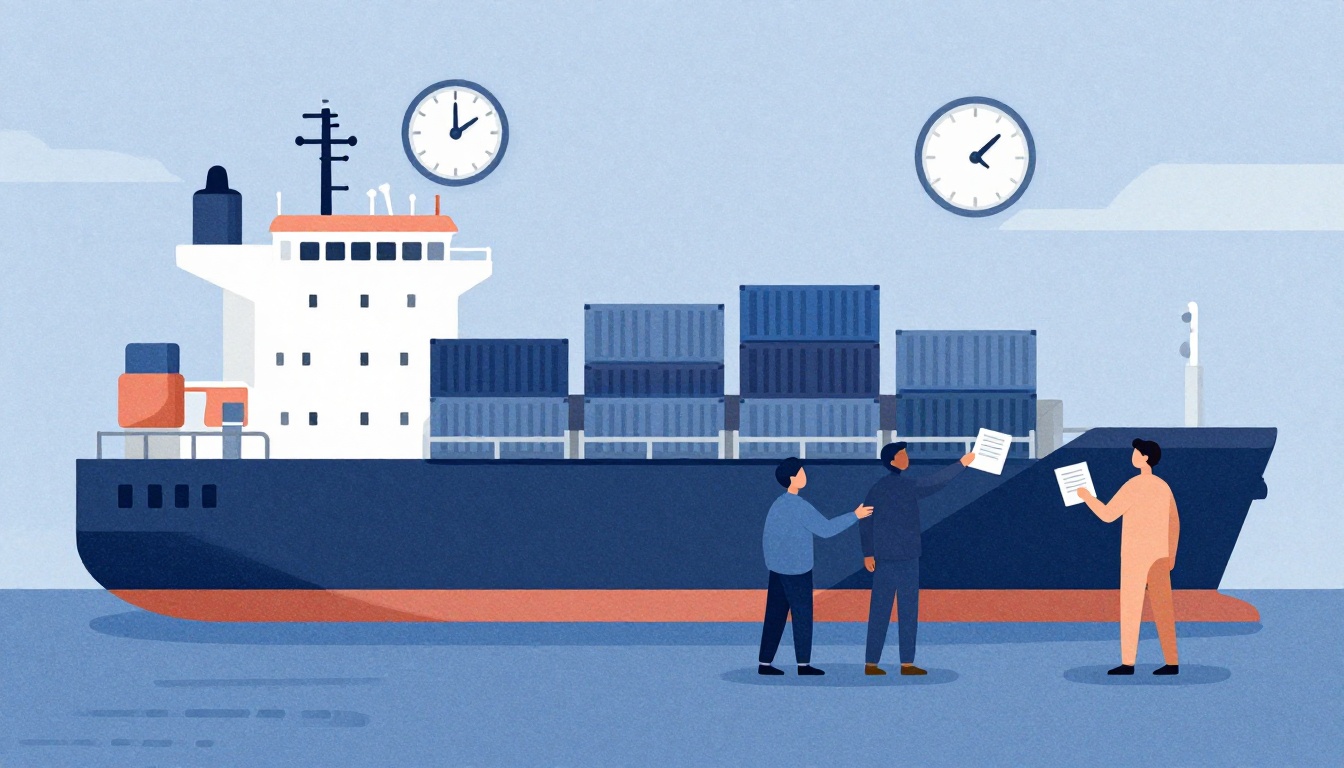
When a vessel sits at port beyond its allowed free time, demurrage fees can escalate quickly—sometimes to tens of thousands of dollars per day. In cross-border trade, the question of who bears these costs is often ambiguous, leading to disputes that erode margins and delay cargo. The root problem is that Incoterms and standard contracts rarely specify every cost scenario, leaving demurrage allocation to chance.
Demurrage is a penalty fee charged when cargo remains at a port, terminal, or rail yard beyond the allotted free time provided by the shipping contract. This fee is typically negotiated and agreed upon in the charter party, the contract between the shipowner and the charterer. In bulk shipping, demurrage rates can reach as high as US$70,000 per day in disrupted markets, making allocation a critical financial risk.
Which of the following best describes demurrage in shipping contracts?
Select one answer.
Why Incoterms aren't enough
Incoterms govern delivery, risk transfer, and certain cost items, but they do not automatically determine who bears demurrage. Even with clauses like CIF, CFR, FOB, or DAP, the Incoterm code does not resolve every additional cost item that arises from supply chain disruptions. For example, under a CIF contract, the seller arranges transport and pays freight, but demurrage at the discharge port may fall on the buyer if the cargo isn't cleared in time. Without explicit contract terms, disputes are common.
Aligning charter party and sales contract terms
A key step is aligning the voyage charter party with the sales contract. The charter party governs the relationship between shipowner and charterer, while the sales contract governs seller and buyer. These two contracts often have different laytime, demurrage, and notice provisions, creating gaps. For instance, including "demurrage as per charter party" in a sales contract does not necessarily incorporate all charter party terms relating to demurrage. To allocate risk clearly, you must specify:
- Laytime: the agreed time for loading and discharging, which starts when the vessel tenders a Notice of Readiness (NOR).
- Demurrage rate: the daily or pro-rata amount payable if laytime is exceeded.
- Despatch: a reward for completing loading/discharge before laytime expires, often at half the demurrage rate.
- Exceptions: events that stop laytime from counting, such as weather, strikes, or customs delays.
- Time bar clauses: deadlines for submitting demurrage claims and supporting documents.
Practical steps to allocate demurrage risk
- Define laytime clearly in both the charter party and sales contract. Specify the number of days, when it starts (e.g., on NOR tender), and what counts as "used" time.
- Set a demurrage rate that reflects market standards and is acceptable to both parties. Use a daily rate with pro-rata for shorter periods.
- Incorporate exception clauses that suspend laytime for events beyond the charterer's control, such as port congestion, customs holds, or force majeure. This protects against delays caused by documentation errors or classification disputes.
- Align the sales contract with the charter party by referencing specific demurrage terms, not just "as per charter party." Include the rate, calculation method, and time bar.
- Use despatch incentives to encourage faster turnaround, but set the rate at half the demurrage rate to balance risk.
- Document everything—the Statement of Facts, signed by the master and receiver, determines the end of the vessel's stay and is the basis for demurrage calculation. Ensure all supporting documents are submitted within the time bar.
Who bears the risk in practice?
Typically, the charterer is liable to pay demurrage when laytime is exceeded. In a voyage charter, the charterer is responsible for loading and discharging within the agreed laytime. If delays occur due to customs or documentation issues, the demurrage meter doesn't care who caused it—the cost lands on the charterer unless the contract explicitly shifts it. In a CIF sale, the seller is the charterer and may pass demurrage costs to the buyer if the buyer causes delay at discharge. In an FOB sale, the buyer often arranges the vessel and bears demurrage risk.
The role of force majeure and geopolitical shifts
Global trade shifts, such as tariff-driven corridor changes, can turn operational necessity into contractual breach. If a contract locks in routing or narrow arrival windows, a shift to an alternative port can trigger demurrage. Force majeure clauses can provide relief, but they must be explicit. For example, if a cargo is detained due to HTS code discrepancies, the delay may be outside the charterer's control, but without an exception clause, the demurrage cost still falls on the charterer.
Quiz: Test your understanding
Which of the following best describes demurrage in shipping contracts?
- A fee charged when cargo remains at a port beyond the allotted free time
- A reward for completing loading before the agreed laytime
- A tax imposed on imported goods
Correct answer: A fee charged when cargo remains at a port beyond the allotted free time
How the Featured Expert Can Help
VERTEX Strategic Group is a boutique professional services firm that facilitates strategic access and institutional execution across governments, infrastructure, commodities, and cross-border trade. They offer specialized procurement, capital, and commodity pathways for qualified institutional mandates. Their expertise in navigating complex jurisdictions can help you structure contracts that allocate demurrage risk effectively. Visit VERTEX Strategic Group to learn more.